На сайте используются cookie файлы
The site uses cookie files
Данный сайт имеет возрастное ограничение!
This site has age restrictions!
Я подтверждаю, что мне, увы, уже давно исполнилось 18 лет

Ukrainian winemaking, together with the entire country, has lived through five wartime years that can only be described as a stress test for survival. A near‑halving of vineyard area, declining processing volumes, the loss of part of the production infrastructure – all of this could have broken the industry, were it not for the inner resilience of Ukrainians. Drinks+ publishes data from the “Ukrainian Wine Market Study”, conducted by the Diia.Business team at the initiative of Wines of Ukraine. Respect is due to the authors – analysing statistics during wartime is a challenge in itself. And this is the first comprehensive study of the situation carried out over the past five extraordinarily difficult years.
Yet despite these dramatic figures, the study reveals a notable positive trend: in 2024–2025, the first signs of recovery appear across Ukraine. We are not seeing a leap or an explosive surge, but rather a quiet yet confident return to growth. We hope this trajectory will shape the future of Ukrainian winemaking.
Between 2019 and 2023, vineyard area fell almost by half – a figure that could sound like a verdict. In 2022 the decline reached –20.9%, and in 2023 a further –23.9%. These are not just statistics: they represent vanished vineyards, abandoned estates, shattered plans. Yet 2024 delivered +6.6%. It was a signal that the sector was reviving faster than experts predicted. And although 2025 tempered optimism – vineyard area for wine grapes fell by 1%, and table grapes by 44% – we suggest viewing these figures comparatively, as evidence that producers are prioritising wine varieties as a strategic choice that may reshape the market structure in the coming years.
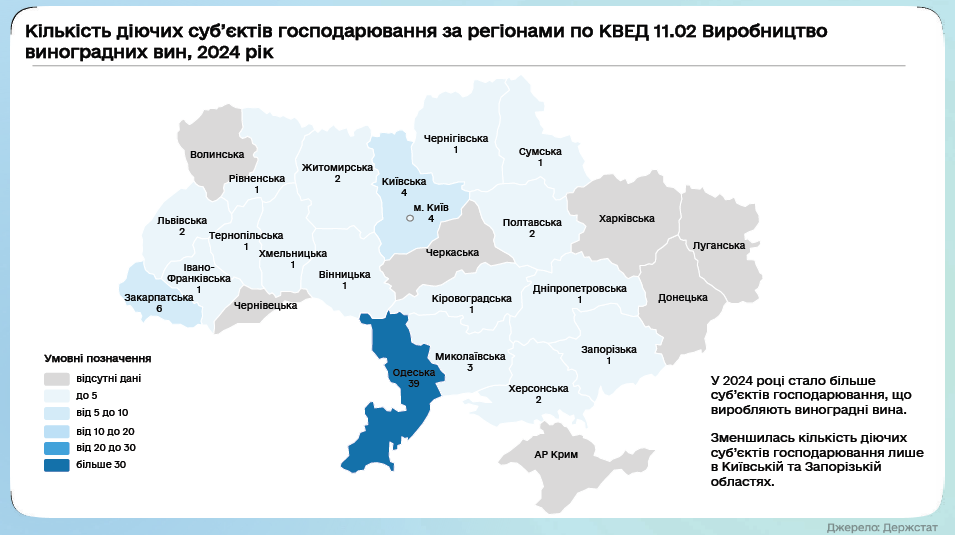
Regional Map: Three Regions Form the Core of Viticulture
Thus, the average yield can be calculated at 40.4 centners/ha.
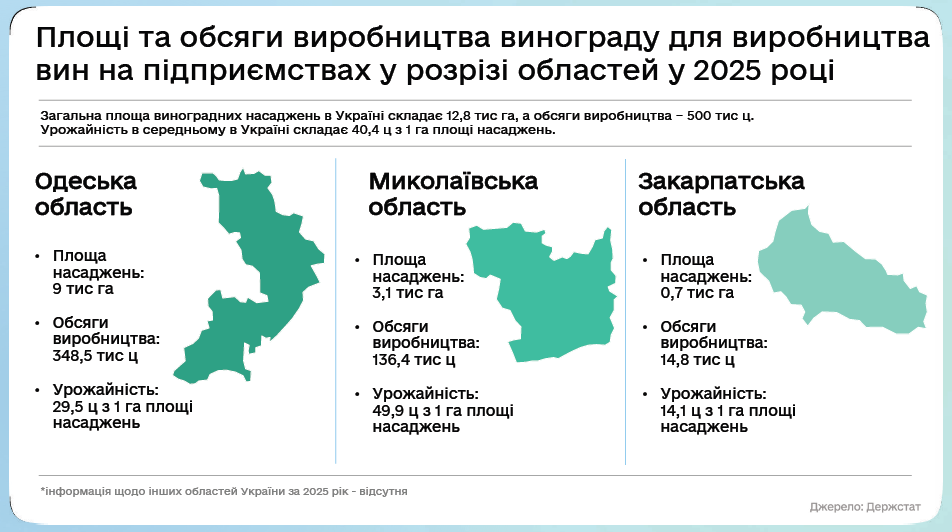
Outlook: if the trend continues, Mykolaiv may become the new centre of viticultural revival, as its yield already exceeds the national average by nearly a quarter. Overall, the sector continues shifting toward the southern regions, yet the study highlights the potential of Zakarpattia.
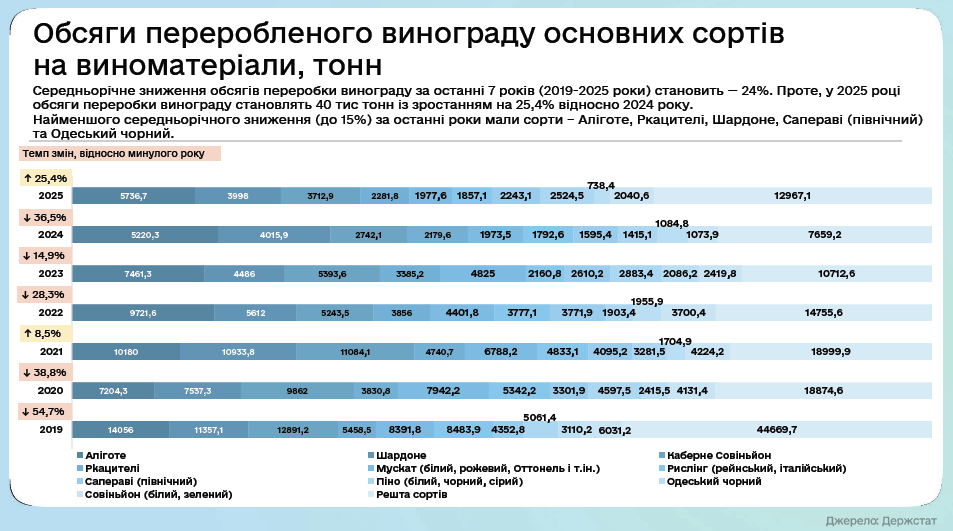
The average annual decline in grape processing volumes between 2019 and 2025 was 24%. In essence, the sector was losing nearly a quarter of its processing volume each year – a trend that could have proved fatal. Yet in 2025, processing volumes increased by 25.4% compared to the previous year.
In 2025, grape processing volumes reached 40 thousand tonnes. This is the first strong indication that producers are returning to full-scale operations and that the industry is regaining momentum.
Varietal Structure: Classics Hold the Market
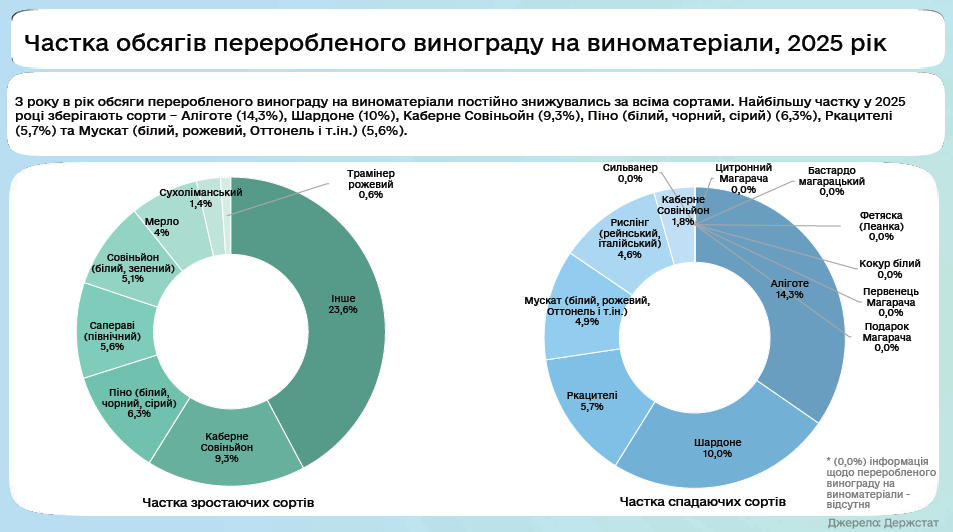
Processing leaders in 2025:
Declining varieties:
Although the Cabernet Sauvignon figures in the study appear inconsistent, the country’s vineyards remain dominated by Aligoté, Chardonnay, Cabernet Sauvignon, Pinot (Blanc, Noir and Gris), Rkatsiteli and Muscat (White, Pink, Ottonel, etc.). The lowest average annual decline (up to 15%) was recorded for Aligoté, Rkatsiteli, Chardonnay, Saperavi (Northern) and Odesa Black.
While classic European varieties continue to dominate, indigenous cultivars such as Odesa Black, Sukholymanskyi White and Citronnyi Magaracha are increasingly shaping the international identity of Ukrainian wine.
We did not see statistical data for Telti Kuruk, yet fresh information shows that several producers are betting on this distinctive variety and expanding plantings. And they are right. The future belongs to Ukraine’s unique indigenous grapes – autochthons are a strategic advantage.
Ukraine clearly has natural prerequisites for producing wines with high ageing potential. Sugar concentration – one of the key parameters defining style and longevity – is central here.
In 2025, the highest mass concentration of sugars was demonstrated by: Traminer Pink, Sauvignon Blanc, Merlot, Odesa Black, Cabernet Sauvignon.
Outlook: if producers focus on premium wines, Ukraine may occupy a niche actively sought by international importers – wines with character, history and distinctive terroir.
Production structure in 2025:
Dynamics 2019–2025:
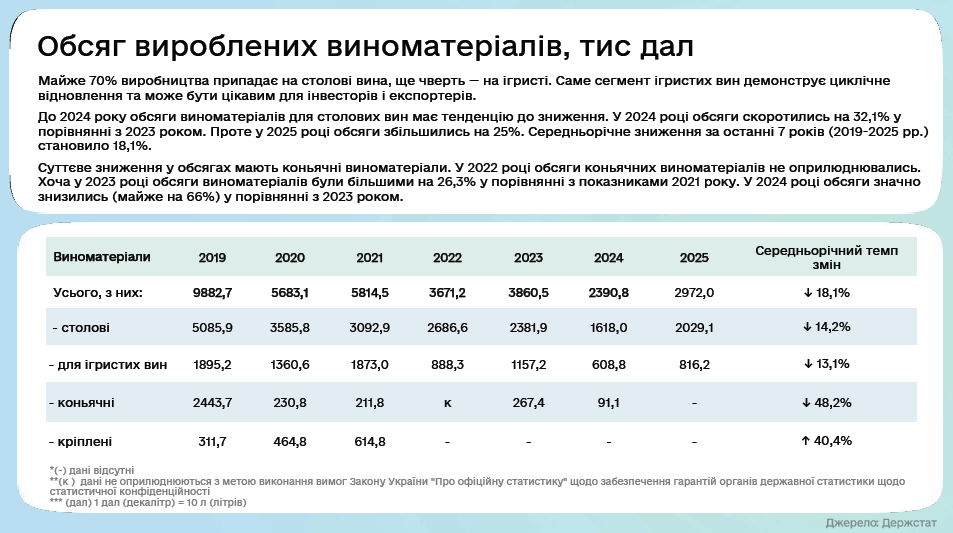
Outlook: excluding fortified wines, the sparkling segment is among the most promising. After cyclical decline, it shows recovery – a potential entry point for investors. Ukrainian sparkling wines already have the potential to compete in Central and Western Europe.
As of 2024, the industry counted 204 operators, the majority being micro and small enterprises. This makes it flexible for experimentation and stylistic exploration, yet limits technical capacity and overall scaling without cooperation with stronger partners.
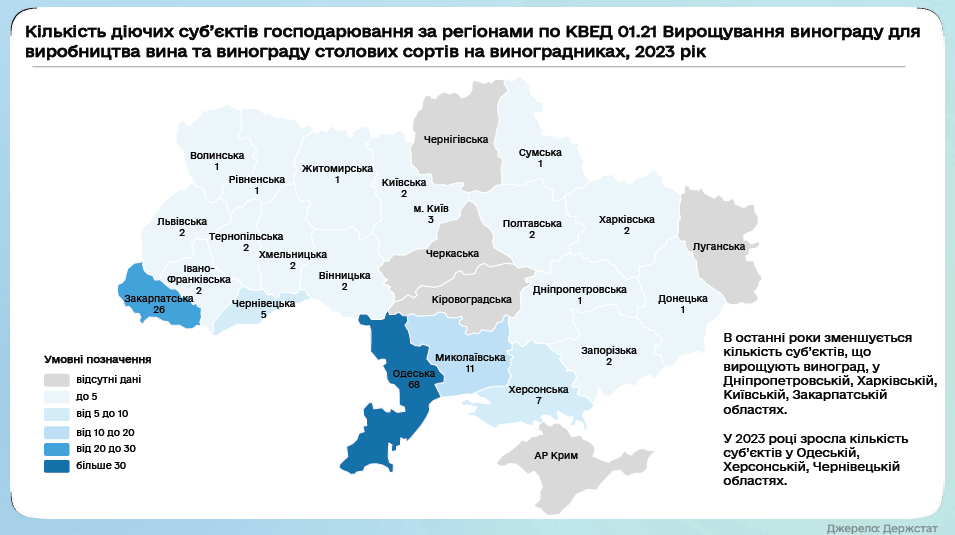
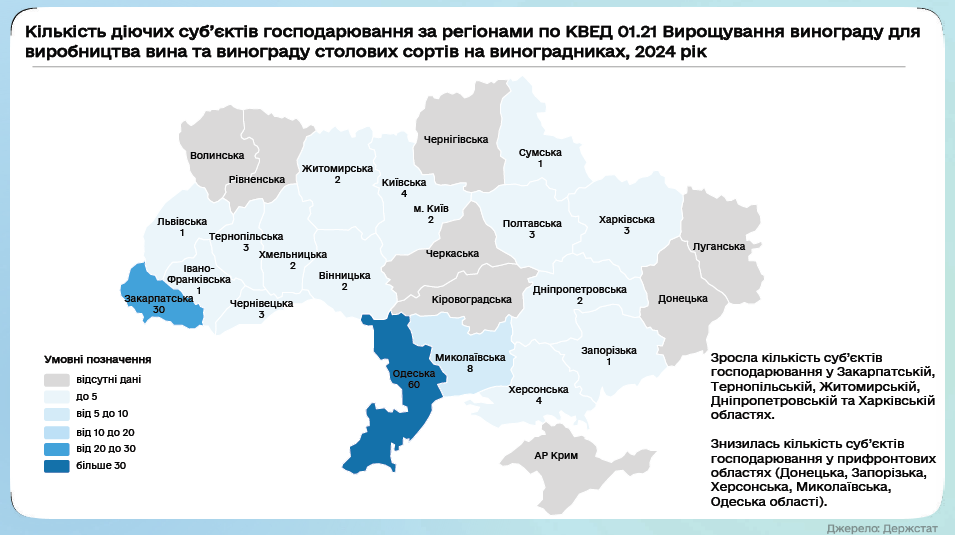
Dynamics by NACE codes:
NACE 01.21 shows that 2023 was a year of recovery for viticulture. After wartime losses in 2022, the sector received initial investments, restored part of the area, and new companies emerged (registry data show active registrations of viticultural enterprises in 2024–2026). The mixed dynamics of 2024 may be due to weather fluctuations (droughts, spring frosts), logistical constraints, rising costs (fuel, fertilisers), and uneven regional recovery (southern Ukraine remains at risk).
Viticulture is capital‑intensive with long payback cycles – fluctuations in 2024 are natural for a recovery period.
NACE 11.02 – grape processing and still wine production (excluding sparkling) – showed a logical decline in 2022 due to wartime destruction, loss of part of the harvest, and logistical barriers. But in 2024 it demonstrates stable recovery, and importantly, wine production exceeded the pre‑war level of 2019 – a clear sign of structural adaptation. The number of new wineries also increased (registry data show active registrations in 2024–2026).
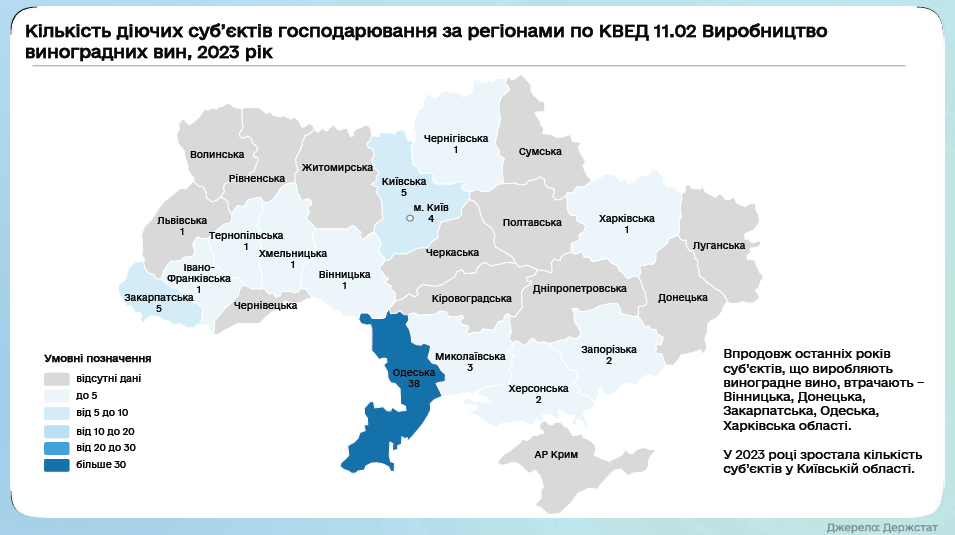
Why is winemaking recovering faster than viticulture? Likely because some producers import wine materials or use reserves. Processing is less dependent on climatic risks. Export opportunities for Ukrainian wine are expanding (successes in EU and Asian markets).
According to industry income statistics, 2023 showed +4.2%, and in 2024 the sum reached 4,509 million UAH. If the 2023 growth repeats in 2025–2026, the industry may return to pre‑crisis levels within two years.
This dynamic is a strong signal for investors. Yes, the industry needs investment – but it is ready to receive it now. After hostilities end, it is easy to predict queues for vineyard plots or shares in wineries.
Viticulture will likely show moderate growth with high volatility. Expect gradual expansion in safer regions (Zakarpattia, Odesa, Mykolaiv – partially), investment in irrigation and technology, and an increase in small farms.
Risks remain: climatic fluctuations, high production costs, regional security factors.
Wine production appears set for annual growth of 5–12%. Further export recovery is expected, rising domestic demand for local wines, active development of craft wineries, and integration of Ukrainian wines into international ratings.
The Ukrainian wine industry is entering a phase of structural recovery and modernisation.
Outlook: by 2027, Ukraine can form a new model of the wine industry – focused on craft, export, technology and regional diversification.
Challenges That Cannot Be Ignored
Opportunities Producers Should Develop Today
Drinks+ has repeated for at least five years: wine tourism, given Ukraine’s specifics and its entry into competitive European markets, must become a leading driver of the industry. It is the most logical development path for Ukrainian wineries and the most effective tool.
To promote enotourism locations (wineries, hotels, restaurants) both internationally and domestically, our media group founded the Wine Travel Awards platform – and invites all progressive and active enterprises to join. The new call for nominees begins in November 2026.
The review is based on data from Diia.Business “Ukrainian Wine Market Study” (2019–2025).
⇒ Join our social networks ⇒ Optimistic D+ editors will take this as a compliment.
⇒ Every like is taken as a toast!
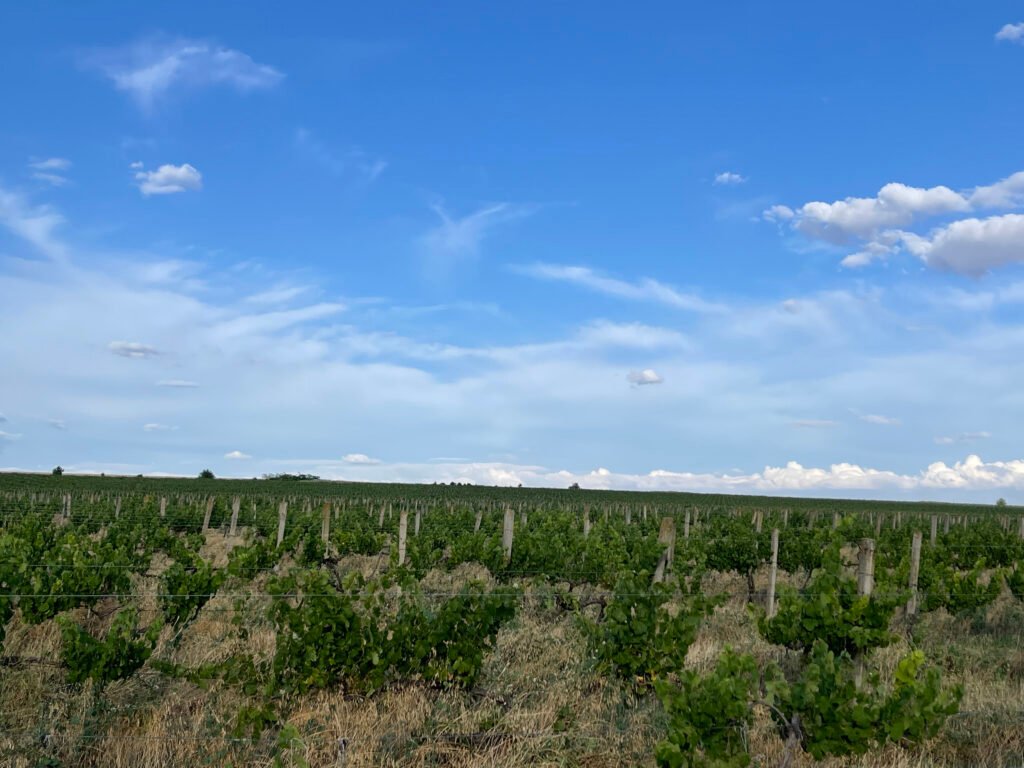
Photo: Diia.Business, Big Wines vineyards